"Best policy in war – thwart the enemy's strategy; second best – disrupt his alliances through diplomacy; third best - attack his army in the field; worst strategy – attack walled cities." –"The Art of War," by Sun Tsu
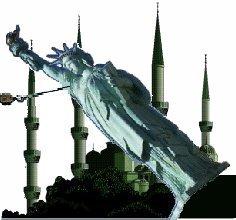
The Fall of Liberty
Underpinning the whole debacle in Iraq has been a complete cultural void and total failure to grasp the psychology of the Iraqi people by the U.S. leadership. This communication chasm, illustrated above, is the prime reason why this surge will fail and why everything else has, and will continue to, run like sand through the fingers of the U.S. forces in Iraq. This said, let's take a look at what are the likely trajectories for this surge in Baghdad?
The most optimistic option, of course, would be a roaring success. In quick step with military planning, district after district is cleared and secured from insurgent and militia forces with little resistance. Sectarian violence evaporates. Armed groups are disbanded and disarmed and the rule of law under the Iraqi Army and police is installed. The Maliki government is stabilized and security spreads countrywide, establishing a unitary, democratic nation sympathetic to the United States.
Well, it's doubtful anyone, even in Washington or the military command, really believes that these aims are feasible and attainable. Non-starter, no-brainer. So the real outcome is likely to be somewhere along the continuum between the partially optimistic and the totally pessimistic perspectives.
The partially optimistic outcome is just that – the achievement a partial and temporary reduction in the scale of violence in Baghdad itself. It is entirely possible that a major change in the scale and logistics of the security presence may decrease violence for a number of reasons. It restricts the movement and autonomy of insurgent and militia activities, at least until they can adjust and adapt to the new circumstances. Punitive actions against the enemy may weaken them or force them to retreat or re-deploy. Furthermore, since the "surge" is known publicly to be of short duration, with the aim of handing security to the Iraqi Army, some insurgents and militias may decide to go to ground temporarily, and bide their time until a U.S. withdrawal to barracks makes operational conditions more favorable for them to restart. Moreover, the security operation could be aided by temporary, passive support from some of the population, especially following the recent extraordinary high level of sectarian mayhem and the lack of any other alternatives.
Conversely, the more pessimistic outcome would involve a palpable inability to sustain any control over the security situation in Baghdad and a worsening of conditions throughout the country. Already, the capital city notwithstanding, there has been an intensification of insurgent, sectarian, inter-tribal and inter-militia violence in nearly every town and province recently. Even in the relatively quite south, where British forces were hoping to gradually begin leaving, fighting is growing worse. More wide-scale, internecine combat could break out, with different local police and military forces taking sides like mafia turf wars, but on a much wider scale.
Furthermore, hundreds of thousands of refugees continue to pour north and south into respective Sunni or Shia areas in order to flee sectarian violence in Baghdad and mixed regions elsewhere. They are bitter, homeless and vengeful. They have no work and are perfect sources of recruitment for insurgents and militias. Larger cities like Mosul and Kirkuk, with mixed populations are already facing a "Baghdadisation." In Kirkuk, which is majority Kurdish, a civil war situation is not ruled out, given the already heightened state of tensions between Sunnis and Kurds, as well as Turkomen, Christian and other minorities. The north could become a battleground dragging in the previously stable Kurdish autonomous. region.
As for the Sunni Al Anbar stronghold, it's already mostly a no-go "liberated" area and is likely to see some intense fighting. But attacking Al Anbar, with its strong tribal links to Saudi Arabia, is very delicate matter, especially while strengthening overall Shi'ite power in the country. At the moment Washington is not making any public boasts about taking Al Anbar back en bloc. However, in the meantime, we may find that it won't be just Anbar but a whole number of others provinces that could have declared "independence," while U.S. forces are pre-occupied with Baghdad.
If sectarian violence and the insurgency is not significantly reduced for more than a short interlude, or rapidly re-emerges on a significant level, the U.S. forces could find themselves trapped in "the mother of all quagmires." While an important part of both the Shia and Sunni population will give them a period of grace, their patience will break very easily. Anger and desperation will erupt and they will turn back with a new resolve to calling on and supporting local defence groups, militias and insurgents to protect them from the attacks of the other community. Once lost this time, the U.S. will never be able to regain the grace or trust of either community again. Consequently, an unstoppable wave of sectarianism and insurgency will sweep over their heads, which they will be incapable of coping with - 21,000 extra troops or not.
It is not at all ruled out that there will be no abatement at all in hostilities. Before the beginning of the new operation, insurgent and sectarian attacks were gaining a momentum and a confidence that has suggested more than just a big fireworks parade before the carnival falls quiet. It seemed to have a new wildness, ferocity and sometimes downright weirdness to it, as though the Sunnis were whipping themselves up into a frenzy for a big battle. Protracted street battles raged, daring assaults on high security targets were launched, helicopters were being shot from the air, and all of this combined to create a sort of atmosphere of gearing up by insurgents for the last fling at the "last chance saloon." The Iraqis sense that after this, failure means the doors of hell will open, regardless of the American presence, its size, or its policies. The insurgents need to win, or to derail the operations sufficiently, for the process to begin.
Moreover, the Sunni insurgency, in particular, is far more coordinated, well-organized, better-equipped and commanded than before. They enjoy greater local support and the morale of their fighters is high. Recently, they have shown exceptional levels of belligerency, tenacity and audacity, as well as adroitness and adaptability. These factors all tend to suggest that the reception for U.S. and Iraqi forces will be much more aggressive and determined than in previous operations.
Ironically, the biggest point of support for the U.S. at the moment is Muqtada al-Sadr. Despite being portrayed, somewhat justifiably, like Robbie Burns' famous "wee, cowering, timorous. beastie," his turncoat collaboration with the U.S. and Iraqi government is an enormous political coup and great tactical advantage for the Americans. In particular his instruction to his followers to stand down has been invaluable in tipping the balance of forces in America's favor. For the U.S. to have had to start by taking on both the Sunni insurgency and Shi'ite Mehdi Army, might have proved unviable.
But just how long this can last is another question. Undoubtedly, part of the recent Sunni sectarian strategy has been to intensify sectarian attacks with the aim of goading the Mehdi into retaliation. Given the public U.S. commitment to clamp down on Shia militias, the Sunnis hoped to use the Mehdi as a second proxy front by forcing them into confrontation with U.S. forces. But if despite the surge, the Sunnis are still able to sustain a high level of sectarian atrocities, then at some point, the unrest among the Shi'ite public will force militia elements into action from below, with or without Muqtada al-Sadr. Once the population begins to feel that the U.S. cannot protect them, then they will demand the militias take matters back into their own hands. They will want to counter-attack and they will attack the U.S. simultaneously in an effort to drive them out of their way, so as to have a free run at the Sunnis. This would stretch U.S. forces and, in turn, embolden the Sunnis to also intensify their own attacks on American forces.
It is quite possible, that Shi'ite unrest could quickly develop into an uprising, or a sort of "Iraqi intifada", rather than a purely sectarian movement or just an insurgency. Sadr City could explode and become a cause célèbre for Shias nationally and internationally. Where nearly all of the 2 million strong population is armed this would be more like a revolution. It would quickly spread throughout East Baghdad and even across the Tigris River into the Sunni West. What began as a so-called U.S. surge would recoil upon them in the form of a popular tsunami engulfing American forces. They would be forced to raise the white flag and escape, not just formally retreat. U.S. casualties could be catastrophic. Pictures of surrounded troops being pulled from humvees and beheaded on the streets could flash across TV screens worldwide. A Vietnam-scale movement could develop in the U.S. The resignation, by one means or another, of the Commander-in-Chief, would be on the cards.
In old-fashioned military terms, what the U.S. is doing is "laying siege" to a city. They are playing with fire. Should they pursue their promised, aggressive policy of bringing in heavy armaments, tanks and air support in order to root out insurgents in a densely packed urban setting, they risk causing massive collateral damage. Civilian deaths from heavy fighting could start to reach numbers where talk of massacres starts to become real. Troops stretched to breaking point can make big mistakes. Situations like this are pregnant with the accidental, the ill-thought out and the outrageous. This is another scenario which runs the risk of turning passive resistance into a mass popular uprisings. In the case of atrocities and massacres by U.S. forces and/or in collusion with Iraqi Army troops, cries might well be heard for the indictment of U.S. commanders for war crimes.
In any of the scenarios above, the Iraqi government could easily fall. The current "hard man" Maliki is quite capable of jumping ship and moving in the direction of either comfortable exile or joining a movement for an independent Shi'ite state. The Army and police would turn against the U.S. army and join forces with the militias and insurgents. The U.S. would be left with out any popular support, without a government, a mandate or a real state to save.
Whatever Bush or Gates' plans are for the future is irrelevant. The surge has been presented as the last U.S. battle. Whatever the outcome, after all they have been through; the Iraq people will not stand for any more projects, plans or promises from the U.S. in the future. There are no more chances. The U.S. is gambling away its last reserves of support, trust and belief. When it fails, every section of society will turn against it.