
This article belongs to Addictions Anonymous column.
In this series of columns I describe a universal and secular self-help program for recovery from addiction. It is universal because it includes all addictive behaviors in a single program. It is secular because it avoids controversial references to religious themes while preserving and developing the philosophy of the original Twelve Steps written by William Wilson for Alcoholics Anonymous.
I think there is only one disorder that underlies all the different addictions, a disorder I call the Addictive Response Pattern. After treating different addictions in specialized programs and attending many self-help groups as a guest, I decided that specialization is a disservice because such specialized programs, whether they are offered by professionals or by self-help organizations, ignore a fundamental problem. By focusing one only one addiction at a time they increase the risk of substitute addictions, ignore other addictions and delay necessary personal growth.
With regard to religion, the inclusion of prayer and references to God has led the courts to identify Alcoholics Anonymous as a religious organization. This presents legal and social problems that I will explain in later columns. Also, many new members find references to religion distracting. There is no research to suggest that religion is necessary for a spiritual recovery program. Religion and spirituality are not the same. A moral, safe and comfortable philosophy of living need not depend on religion. Religion is controversial and divisive ina program where unity of purpose is essential. I do not oppose or denigrate religion, but religion is a personal choice, not something that should be mandated or enforced in programs for addiction.
Discussions of religion, like politics and business affairs, simply do not belong in a program devoted to personal growth and change.
Stripped of references to God and to mystical higher powers, the famous Twelve Step philosophy is a wonderful prescription of a better life. It is a model for living that any of us can profit from whether we have addictions or not.
I try to keep my writing simple, but addictions are complicated human problems. I am told by recovering people that my ideas and opinions are best suited to those addicts with some amount of clean and sober time, those who are past the first stages of withdrawal and resigned to the long struggle for quality abstinence and normal living. I tend to agree. If you are just starting out in a personal recovery, you may want to save this material for later study or perhaps take it in small doses at first.
I support and encourage long-term membership in self-help groups for addiction although, inevitably, some members of Twelve Step groups may not agree with my interpretation of these programs and with my elimination of God from the language. Recovering addicts have many choices among programs and should be encouraged to make their own decisions and to explore all the different ways of dealing with addiction. If one thing doesn't work after giving it an honest effort, they should try something else.
There is no one best path to normal living for every addict. Some people have only one addiction while others have many. Some people will be able to quit with only a simple pledge or resolution; most others will need stronger measures and more time. Some will put their faith in self-help groups. Some will become involved in religion. Some will try the newer drugs that offer help with cravings. Although I usually don't recommend it, some will be able to moderate an addiction so that it no longer damages their lives. Each individual must find his or her own way out of addiction in their own good time, but they must never give up and never stop trying.
Who am I to talk about addictions
Other than an early devotion to tobacco, work and foods I shouldn't eat, I have been fortunate in life to escape any long-term, life-shortening addiction to activities and substances. I stopped smoking long ago at the age of thirty-one, and am still tobacco-free over thirty-five years later. I quit working for money, glory and power over ten years ago, and in retirement I can work or not as I choose. Many days find me doing nothing productive and just having fun. I've learned that I don't have to be what I was, that I can enjoy change. The important thing is not to act and think like someone addicted to work, and I don't think I do that any longer. Food? Well, there's been some moderate success there in the sense of not being what I used to be or being quite what I'd like to be yet. Proper eating is a daily struggle for many of us, a struggle in which total food abstinence is impossible. Yes, there is at least one addiction for which moderation and control are necessary.
Learning to eat a healthy diet, of course, is always possible and demands constant attention. If we all waited to be perfect before contributing what we can, we wouldn't have much to share.
My qualifications for writing on addictions are mostly a Ph.D. in psychology and years of clinical work along with years of research on problem behavior in general and addictions in particular.
It has been my good fortune to watch and help others striving to overcome addiction, people who were determined to build rewarding lives for themselves and their families. I believe that recovery is not only possible, but inevitable when the person learns new ways of thinking and acting.
I know that many people who come to treatment and to self-help groups are intellectually, culturally and emotionally not able to follow a long text, no matter how basic it is. That's one of the reasons why meetings and fellowship are so important. I implore those who do find this or other writing of value to use the old pattern of each one teach one, so that important ideas can be communicated in whatever time or language it takes. Read or explain what you think are important parts of a recovery program to others, but never shove it down their throats. In helping others, you help yourself through your service. In giving others real choices, you remove your own ego from the game and learn to do what is best for others.
The reader should remember that what I write is not literature approved by the national service office of any Twelve Step group. The person new to a recovery program should read all of their home organization's approved literature before attempting material like this.
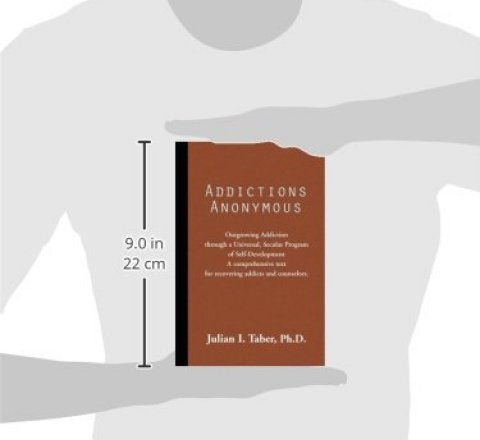
My title, Addictions Anonymous, does not imply the existence of any formal organization, group or society. It does imply, however, that we may all be facing a much larger set of problems than we imagined when we first began to think about getting rid of a particular addiction. Hopefully, in taking a wider view of a task, we may find it easier to accomplish.
The author holds copyrights to this material. It can be distributed for any educational purpose but is not to be sold or used for personal profit.
With regard to religion, the inclusion of prayer and references to God has led the courts to identify Alcoholics Anonymous as a religious organization. This presents legal and social problems that I will explain in later columns. Also, many new members find references to religion distracting. There is no research to suggest that religion is necessary for a spiritual recovery program. Religion and spirituality are not the same. A moral, safe and comfortable philosophy of living need not depend on religion. Religion is controversial and divisive ina program where unity of purpose is essential. I do not oppose or denigrate religion, but religion is a personal choice, not something that should be mandated or enforced in programs for addiction.
Discussions of religion, like politics and business affairs, simply do not belong in a program devoted to personal growth and change.
Stripped of references to God and to mystical higher powers, the famous Twelve Step philosophy is a wonderful prescription of a better life. It is a model for living that any of us can profit from whether we have addictions or not.
I try to keep my writing simple, but addictions are complicated human problems. I am told by recovering people that my ideas and opinions are best suited to those addicts with some amount of clean and sober time, those who are past the first stages of withdrawal and resigned to the long struggle for quality abstinence and normal living. I tend to agree. If you are just starting out in a personal recovery, you may want to save this material for later study or perhaps take it in small doses at first.
I support and encourage long-term membership in self-help groups for addiction although, inevitably, some members of Twelve Step groups may not agree with my interpretation of these programs and with my elimination of God from the language. Recovering addicts have many choices among programs and should be encouraged to make their own decisions and to explore all the different ways of dealing with addiction. If one thing doesn't work after giving it an honest effort, they should try something else.
There is no one best path to normal living for every addict. Some people have only one addiction while others have many. Some people will be able to quit with only a simple pledge or resolution; most others will need stronger measures and more time. Some will put their faith in self-help groups. Some will become involved in religion. Some will try the newer drugs that offer help with cravings. Although I usually don't recommend it, some will be able to moderate an addiction so that it no longer damages their lives. Each individual must find his or her own way out of addiction in their own good time, but they must never give up and never stop trying.
Who am I to talk about addictions
Other than an early devotion to tobacco, work and foods I shouldn't eat, I have been fortunate in life to escape any long-term, life-shortening addiction to activities and substances. I stopped smoking long ago at the age of thirty-one, and am still tobacco-free over thirty-five years later. I quit working for money, glory and power over ten years ago, and in retirement I can work or not as I choose. Many days find me doing nothing productive and just having fun. I've learned that I don't have to be what I was, that I can enjoy change. The important thing is not to act and think like someone addicted to work, and I don't think I do that any longer. Food? Well, there's been some moderate success there in the sense of not being what I used to be or being quite what I'd like to be yet. Proper eating is a daily struggle for many of us, a struggle in which total food abstinence is impossible. Yes, there is at least one addiction for which moderation and control are necessary.
Learning to eat a healthy diet, of course, is always possible and demands constant attention. If we all waited to be perfect before contributing what we can, we wouldn't have much to share.
My qualifications for writing on addictions are mostly a Ph.D. in psychology and years of clinical work along with years of research on problem behavior in general and addictions in particular.
It has been my good fortune to watch and help others striving to overcome addiction, people who were determined to build rewarding lives for themselves and their families. I believe that recovery is not only possible, but inevitable when the person learns new ways of thinking and acting.
I know that many people who come to treatment and to self-help groups are intellectually, culturally and emotionally not able to follow a long text, no matter how basic it is. That's one of the reasons why meetings and fellowship are so important. I implore those who do find this or other writing of value to use the old pattern of each one teach one, so that important ideas can be communicated in whatever time or language it takes. Read or explain what you think are important parts of a recovery program to others, but never shove it down their throats. In helping others, you help yourself through your service. In giving others real choices, you remove your own ego from the game and learn to do what is best for others.
The reader should remember that what I write is not literature approved by the national service office of any Twelve Step group. The person new to a recovery program should read all of their home organization's approved literature before attempting material like this.
My title, Addictions Anonymous, does not imply the existence of any formal organization, group or society. It does imply, however, that we may all be facing a much larger set of problems than we imagined when we first began to think about getting rid of a particular addiction. Hopefully, in taking a wider view of a task, we may find it easier to accomplish.
The author holds copyrights to this material. It can be distributed for any educational purpose but is not to be sold or used for personal profit.
|
Some of our content may be related to gambling.    |